
The Challenge
During proof-of-concept (POC) testing, the client’s customers had to simulate multiple participating banks or rely on support from the technical team and partner banks. When any participant was unavailable, testing activities could be delayed, extending the overall POC timeline.
Besides, the system’s complexity with intricate business logics and multiple testing toolkits, required comprehensive coverage to ensure accuracy and reliability across simulated banking scenarios.
The client, therefore, needed a Virtual Bank Simulator that could replicate the behavior of participating banks and allow users to independently configure and select test scenarios without relying on external participants.
The Solution
CMC Global collaborated with the client to design and develop a Virtual Bank Simulator that replicates the behavior of participating banks during proof-of-concept (POC) testing.
Our team developed the technical design, including database schemas, API documentation, and test scenarios, and implemented the solution through two core components:
1. Front-End Development: ReactJS Virtual Bank Simulator
We built a web-based simulator that allowed bank clients to test the client’s network through configurable transaction scenarios.
The interface enabled users to define testing parameters, execute predefined workflows, validate individual test steps, and review results without requiring direct involvement from other participating banks.
Key features included:
- SQL Script Integration: Supported the use of SQL scripts to prepare test data and configure testing scenarios.
- Flexible Role Configuration: Enabled users to configure and assign roles representing different participating banks within a test scenario.
- Scenario Execution & Step Validation: Allowed users to trigger test scenarios, progress through defined transaction steps, and inspect the results of each step.
- Test Result Reporting: Captured and presented execution outcomes to support analysis, issue identification, and troubleshooting.
2. Back-End Development: Spring Boot & Karate
We developed backend services using Spring Boot and integrated the Karate testing framework to support API validation and automated test execution.
This architecture connected the simulator’s front end with the underlying testing services, enabling consistent scenario execution and more efficient API testing.
Key capabilities included:
- Automated API Testing: Leveraged Karate to define and execute API test cases, helping validate service behavior across different testing scenarios.
- Readable Test Case Development:Used Karate’s Gherkin-based syntax to make API test scenarios easier to define, review, and maintain.
- Front-End and Back-End Integration: Established communication between the ReactJS interface and backend services to support scenario configuration, execution, and result retrieval.
- Automation Pipeline Integration: Enabled API test cases to be incorporated into automated testing pipelines, supporting repeatable validation and more efficient testing workflows.
The Result
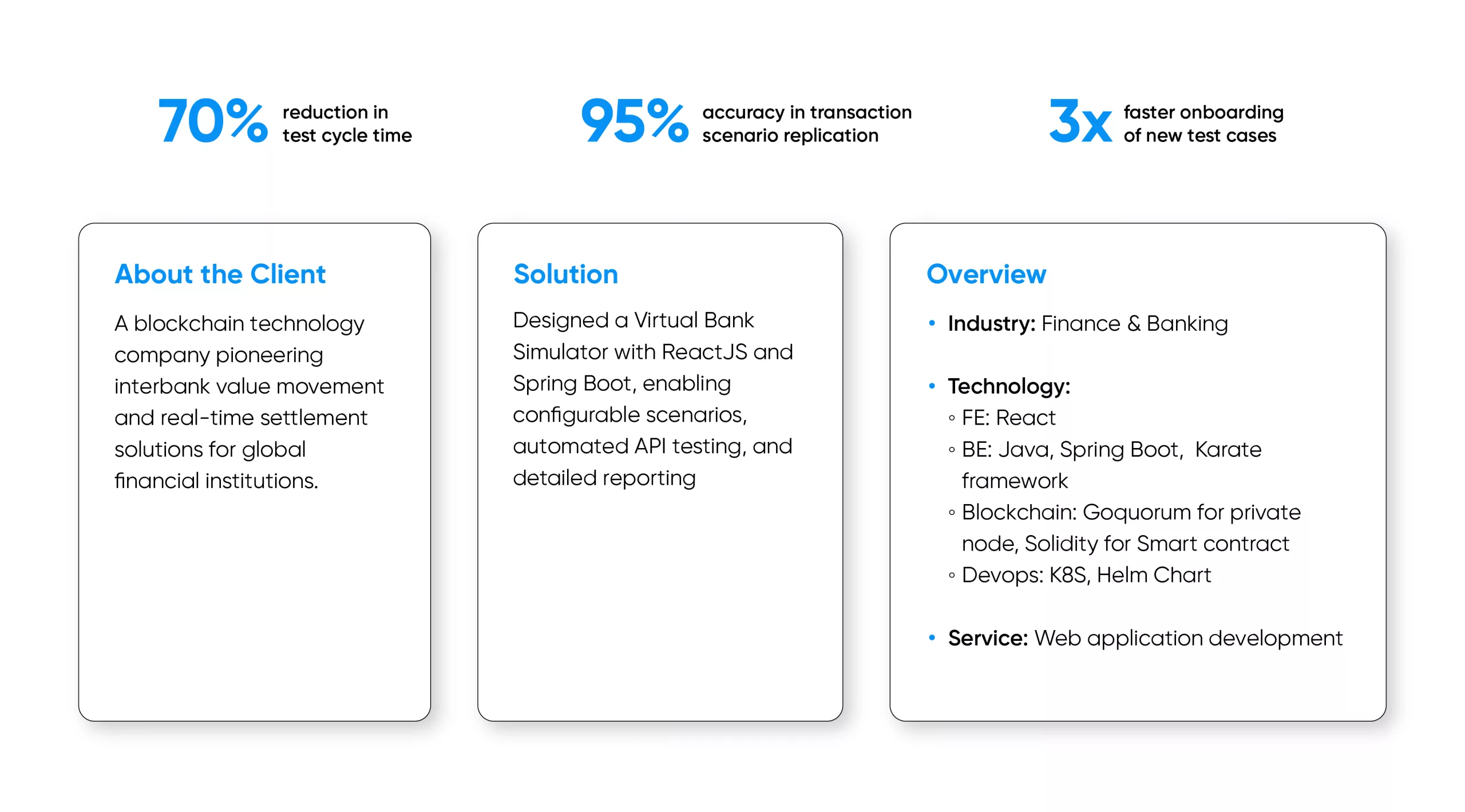
The solution delivered significant improvements in testing efficiency, transaction simulation accuracy, and test case onboarding speed.
- 70% reduction in test cycle time
- 95% accuracy in transaction scenario replication
- 3x faster onboarding of new test cases