The Challenge
The client faced challenges in managing and governing its growing data landscape due to an unstructured data architecture and the lack of a centralized governance framework.
Limited visibility into data origins and transformations made it difficult to track data lineage and ensure the reliability of business insights.
Inconsistent data quality further affected the accuracy of analysis and decision-making, while gaps in security controls increased the risk of unauthorized access and compliance issues.
Additionally, inefficient data management processes contributed to rising operational costs.
To address these challenges, the client sought to establish a scalable data governance framework that would improve data traceability, strengthen quality control and security, automate data validation processes, and optimize operational costs.
The Solution
Our team began by conducting a comprehensive assessment of the client’s existing data platform, reviewing its architecture, data pipeline frameworks, design patterns, naming conventions, data warehouse models, storage optimization, and data distribution.
Based on the client’s requirements, we redesigned the data warehouse using a Medallion Lakehouse architecture, following industry best practices. The new architecture organized data into three structured layers: Bronze, Silver, and Gold, representing different stages of data processing and refinement.
The team also established standardized naming conventions across data entities to improve consistency, simplify maintenance, and support long-term scalability.
To improve pipeline performance and reliability, we developed a scalable data pipeline framework designed for cost efficiency, fault tolerance, and streamlined operational management. The solution was further integrated with Microsoft Purview to strengthen data governance across the platform.
This integration provided end-to-end data lineage tracking, automated data quality monitoring, and enhanced security through role-based access controls and compliance tracking.
Throughout implementation, CMC Global followed an agile delivery approach, organizing work into structured sprints with clearly defined responsibilities.
Regular stakeholder engagement and alignment helped secure buy-in for the proposed architecture and ensure the solution addressed the client’s operational and governance requirements.
The Result
The redesigned Medallion Architecture on a Lakehouse platform achieved significant results:
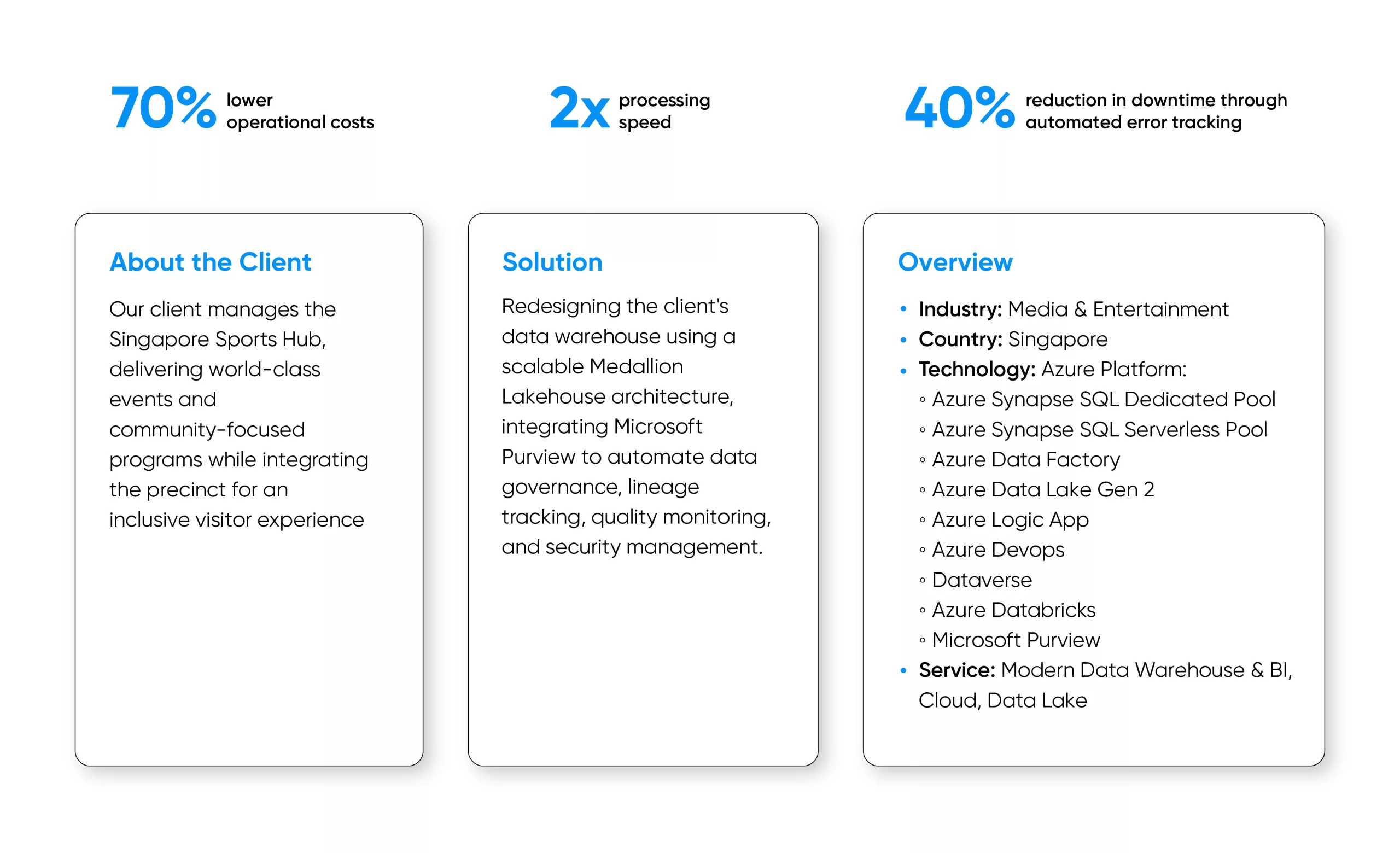
- 70% lower operational costs.
- 40% reduction in downtime through automated error tracking.
- 2x processing speed.
- Faster error recovery with tiered data layers.
- Elastic scaling with reusable pipelines.
- Seamless integration with Microsoft Purview for data governance.
- Future-proof storage enabling easy migration.