By 2026, data generation has reached unprecedented levels, driven by AI, IoT, and real-time customer interactions. Businesses no longer just need a CRM; they need an intelligent, unified platform to turn data into action. Salesforce remains that platform, trusted by startups and Fortune 500s alike.
In this updated tutorial, you’ll learn what Salesforce is, its core benefits for 2026, and how its evolving ecosystem meets modern business demands.
What Is Salesforce?
Salesforce is a cloud-based Customer Relationship Management (CRM) platform, but today it’s much more: it’s an integrated AI-first business operating system. It helps companies manage customer data, sales, marketing, service, and commerce; all while embedding predictive AI, real-time analytics, and automated workflows.
Modern Salesforce capabilities include:
- AI-driven customer segmentation and next-best-action recommendations
- Unified data management across dozens of channels
- Built-in tools for privacy compliance (e.g., GDPR, CCPA, and emerging 2026 regulations)
With over 5,000 third-party integrations and native connectors, Salesforce remains one of the most flexible and trusted CRM ecosystems.
6 Benefits of Salesforce (2026 Update)
#1 Increased Revenue Through AI Automation
In 2026, manual data entry is a competitive liability. Without Salesforce, teams waste hours on admin work: data cleansing, lead assignment, follow-up tracking. Salesforce’s Einstein AI now automates these tasks, including intelligent lead scoring, automated email sequences, and even deal-risk prediction. The result: your team spends more time building relationships, closing deals, and driving long-term profitability.
#2 Smarter Time Management with Predictive Tools
Time management has evolved beyond simple calendars. Salesforce now includes AI-powered prioritization: it suggests which leads to contact first, which accounts may churn, and which tasks will most impact revenue. With all customer history, interaction logs, and planning tools in one place, you stop searching and start acting.
#3 Effortless Account Planning with AI Insights
Account planning in 2026 means predictive analytics. Salesforce automatically surfaces trends, cross-sell opportunities, and risk signals for each account. You can create personalized customer plans in minutes, not days. Clients receive exactly what they need, while you stay organized and proactive.
#4 Trusted Reporting with Real-Time Data
Data volume is overwhelming but Salesforce’s reporting now includes real-time ingestion and AI-assisted analysis. You can blend data from social media, website behavior, CRM, and even offline sources. Einstein automatically flags anomalies, forecasts trends, and verifies data quality. The result: numbers you can trust, and insights you can act on immediately.
#5 Hyper-Personalized Customer Satisfaction
Today’s customers expect brands to know them instantly. With Salesforce, agents and salespeople see full context: past purchases, support tickets, preferences, and even sentiment analysis from recent interactions. Less time on admin means more time on genuine connection. Happy customers become brand advocates—a proven growth driver in 2026’s trust-driven economy.
#6 Team Collaboration with AI-Augmented Tools
Salesforce’s “Chatter” has evolved into an AI-enhanced collaboration hub. Team members can discuss accounts, share real-time dashboards, and receive automated summaries of client updates. When sales, marketing, and service align on one platform, your business becomes more cohesive, responsive, and efficient.
What Made Salesforce an Instant Hit And Why It Still Leads in 2026
When Salesforce launched in 1999, it was the first internet-delivered CRM, eliminating server costs and setup complexity. That cloud-first, pay-as-you-go model democratized access to enterprise software.
Fast-forward to 2026: Salesforce continues to lead because it evolved from a CRM into a complete Customer 360 platform: integrating AI, data lakes, automation, and industry-specific solutions. Its relentless focus on user-friendly design, security, and scalability keeps it ahead of newer competitors.
Salesforce Platform Services (2026 Edition)
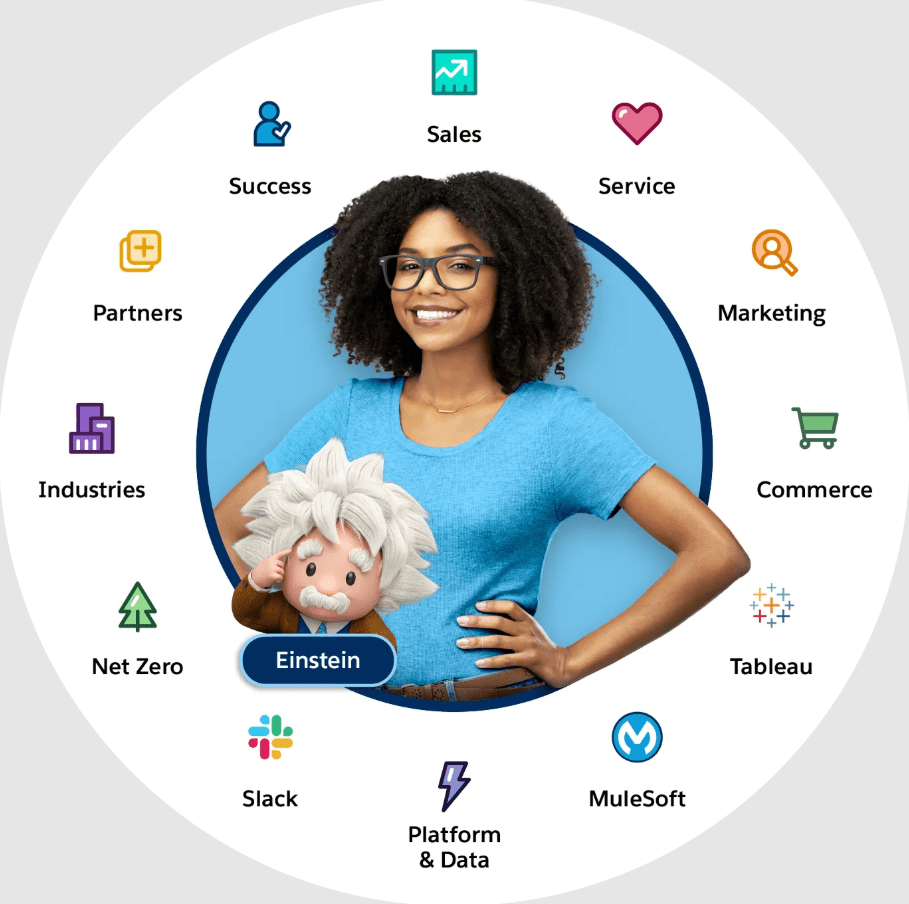
These are the core services powering modern Salesforce implementations.
#1 Salesforce Customer 360
Now more connected than ever, Customer 360 unifies sales, service, marketing, commerce, and more. Key components in 2026 include:
- MuleSoft for real-time data integration across any source
- Einstein AI for predictive scoring and autonomous workflows
- Tableau for interactive, AI-enhanced visual analytics
#2 Salesforce Digital 360
Digital 360 merges Marketing Cloud, Commerce Cloud, and Experience Cloud into a single engagement layer. New in 2026: cross-channel journey orchestration with AI-driven personalization, plus unified customer audiences across web, mobile, social, and email.
#3 Salesforce Einstein AI
Einstein is now embedded in every cloud. It automates data prep, model training, and deployment, making AI accessible to non-technical users. From sales forecasting to service case routing, Einstein saves hours of manual work.
#4 Salesforce Lightning
Lightning remains the platform-as-a-service (PaaS) for building custom apps. Its component-based architecture and drag-and-drop app builder allow rapid development without coding. In 2026, Lightning also supports low-code AI integration and seamless migration from legacy systems.
#5 AppExchange
The leading enterprise app marketplace, AppExchange offers thousands of free and paid apps, plus certified consulting partners. Whether you need industry-specific solutions or compliance tools, AppExchange extends Salesforce’s native power.
#6 Tableau
Tableau is now fully woven into Salesforce’s analytics fabric. It provides dynamic dashboards, data preparation (Tableau Prep), embedded analytics, and CRM Analytics (formerly Tableau CRM). Organizations can explore data visually and share insights across teams in real time.
The Bottom Line for 2026
Salesforce is no longer just a CRM, it’s a complete business transformation platform. By unifying sales, service, marketing, commerce, and AI, it allows enterprises to build lasting customer trust with less effort. Automation, real-time insights, and data unification are no longer optional; they’re essential. And Salesforce delivers all of it in one integrated ecosystem.
If you’re looking to implement or optimize Salesforce in 2026, reach out to a trusted consulting partner like CMC Global. We can help you navigate the latest features and unlock the full potential of your customer data.
Have questions? Contact us anytime.