The Challenge
The client processed hundreds of thousands of supplier invoices annually across Southeast Asia, using multiple systems, including SAP, local ERPs, and spreadsheets. This fragmented process created several operational and financial challenges:
- Manual Processing: Staff had to cross-check invoice line items in Excel, making the process time-consuming, labor-intensive, and prone to errors.
- Invoice and Tax Discrepancies: Duplicate or missing invoices and incorrect tax calculations, including import duties on ingredients, led to potential financial losses.
- Inefficient Audits: Quarterly audits took weeks to complete while covering only a small portion of transactions, limiting visibility into financial discrepancies.
- Limited Payment Visibility: The client lacked a consolidated view of outstanding payments, making it difficult to track cash flow and plan supplier payments for raw materials.
These challenges increased administrative costs, financial risks, and potential regulatory penalties, making it harder for the client to scale operations in a food market growing by 8% annually.
The Solution
CMC Global implemented an automated invoice processing workflow using IBM BPM and generative AI to streamline invoice handling, validation, and exception management.
The process begins with automated invoice intake, where IBM BPM triggers background workflows to collect invoices from emails and vendor portals in various formats, including PDFs, images, and Excel files.
Generative AI then extracts invoice data and interprets contextual differences in terminology, such as recognizing “Freight” as “Shipping” and “VAT” as “Tax,” across Vietnamese and English documents.
Next, IBM BPM performs automated three-way matching, comparing extracted invoice data against purchase orders (POs) and goods receipts in SAP to identify discrepancies, such as mismatched ingredient quantities.
Business rules automatically resolve minor issues within predefined tolerances, including small rounding differences.
For significant discrepancies, IBM BPM routes exceptions to analysts, supported by AI-generated explanations to help identify potential issues, such as duplicate invoices.
The Result
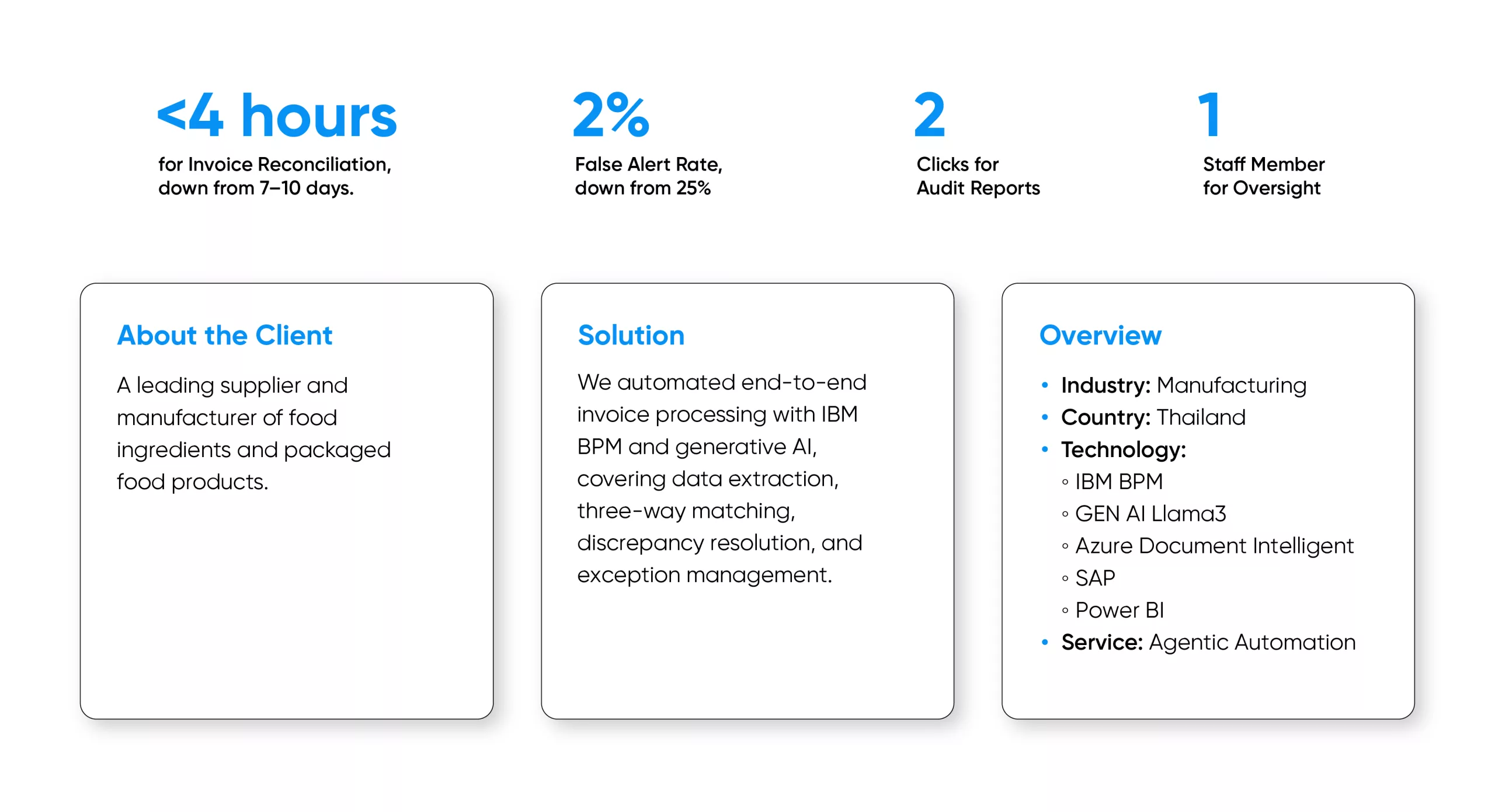
The project has achieved measurable outcomes in cost savings and operational efficiency
- <4 hours for Invoice Reconciliation, down from 7–10 days.
- 2% False Alert Rate, down from 25%
- 2 Clicks for Audit Reports
- 1 Staff Member for Oversight