

The Challenge
The client aimed to develop a dedicated payment app to facilitate seamless transactions and support payment-related activities across merchant accounts. To achieve this, the company needed a reliable development partner capable of delivering the app within a tight timeline, accelerating its time-to-market while maintaining development quality.
At the same time, the client sought to optimize development costs and resource allocation without compromising the app’s functionality or overall performance.
The Solution
CMC Global conducted a comprehensive analysis of the client’s business requirements, target audience, and competitive landscape to define the specifications for the payment application. The team evaluated existing market solutions to identify commonly adopted functionalities and potential differentiating features.
Based on these findings, CMC Global established an end-to-end software development lifecycle covering six key stages: requirement analysis, architecture and UX/UI design, implementation of functional and non-functional requirements, testing, release (SIT, UAT, and go-live), and documentation.
Building on the initial assessment, CMC Global proposed a solution comprising two interconnected portals: an Admin Portal and a Payment Portal. The team developed detailed business and technical requirements, along with a functional map that prioritized application features and screens based on their expected value to end users.
CMC Global also provided cost and timeline estimates for developing a dynamic prototype, proof of concept (PoC), and minimum viable product (MVP), helping the client plan the development roadmap and allocate resources effectively.
For the Admin Portal, the proposed functionalities covered authentication, user management, business and member profile management, transaction management, and issue management.
Meanwhile, the Payment Portal was designed to support essential merchant payment activities through three main functional areas. Authentication enabled users to log in through the business website or a default URL. Payment Management allowed users to view order summaries, make payments, manage subscriptions, add payment methods, and review transaction history.
Billing Address Management provided options to add, view, and edit billing information, ensuring convenient access to payment-related details.
The Result
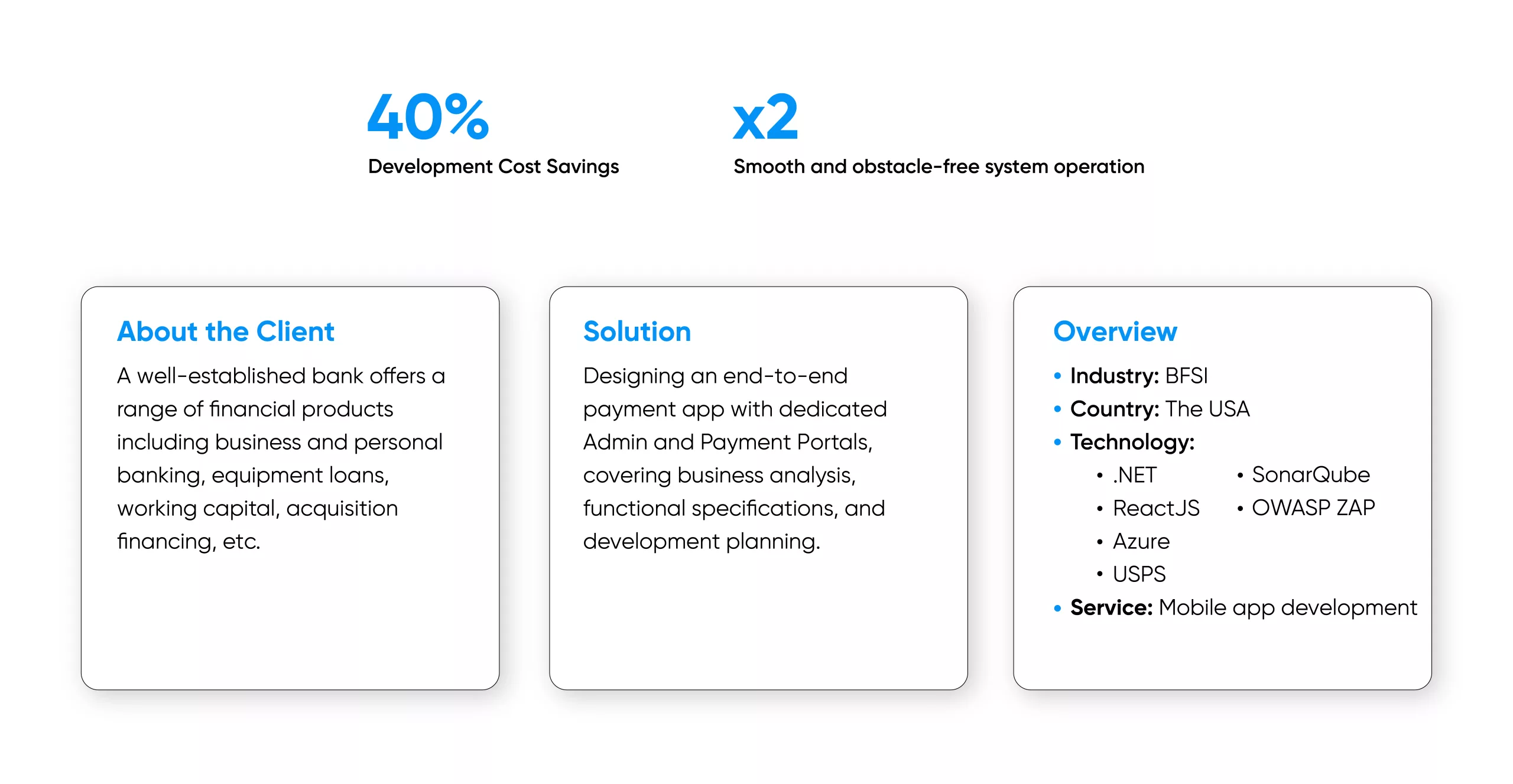
The project has achieved measurable outcomes in cost savings and operational efficiency
- 40% Development Cost Savings
- x2 Smooth and obstacle-free system operation