If healthcare generates nearly a third of the world’s data, why is 97% of it still trapped in legacy silos while clinicians drown in administrative chaos? The pressure to modernize is urgent, yet care delivery cannot afford downtime. Read on to discover how Agentic AI bridges this divide, transforming fragmented records into actionable intelligence without interrupting patient care.
What Is Data Modernization in Healthcare?
Data modernization in healthcare is the process of upgrading how an organization collects, stores, connects, secures, and uses its clinical, financial, operational, and claims data so that information locked in legacy systems becomes accurate, accessible, and actionable. Rather than simply moving data from one location to another, it transforms disconnected systems and spreadsheets into a unified, governed environment that supports care delivery, compliance, analytics, and AI.
A comprehensive healthcare data modernization program typically includes:
- Connecting Siloed Systems: Integrating Electronic Health Record (EHR), claims, laboratory, imaging, pharmacy, and financial systems
- Standardizing Data Models: Adopting unified data models and exchange standards (such as FHIR APIs and HL7 messages) for seamless interoperability
- Improving Data Quality & Identity: Enhancing patient matching, deduplication, metadata management, and validation routines
- Establishing Governance & Security: Implementing standardized privacy controls, consent management, access rules, and audit logging
- Modernizing Infrastructure & Workflows: Transitioning suitable workloads from aging hardware to cloud or hybrid storage, while redesigning clinical and administrative workflows for speed
Where Agentic AI Fits in Healthcare Modernization
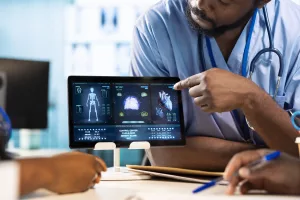
Clinical organizations manage an unforgiving operational reality: care delivery cannot pause. Hospital cannot halt patient admissions or pause emergency room workflows while engineers rebuild database schemas or refactor legacy code.
Agentic AI connects aging platforms with modern workflows, resolving critical friction points across the organization:
-
Connecting Isolated Data Silos: According to Becker’s Health IT, healthcare organisations generated 30% of the world’s data, yet 97% of hospital data goes trapped and unused in isolated databases. The average large health system generates hundreds of millions of clinical events annually. Decades of operational additions leave vital clinical and financial records scattered across incompatible systems. Autonomous agents act as an intelligent coordination fabric, unifying records across disparate databases without demanding disruptive system overhauls.
-
Automating Revenue Cycles and Prior Authorizations: Manual billing workflows, claims follow ups, and insurance verifications continuously strain hospital cash flow, consuming an estimated 25% to 35% of all healthcare spending in the U.S (American Hospital Association, 2026) Intelligent agents handle these multistep administrative journeys autonomously, extracting chart details and submitting authorization requests directly through payer portals to prevent costly denials.
-
Transforming the Patient Experience: Disjointed legacy intake workflows force front desk staff to spend between 8 and 15 hours each week answering calls, managing booking delays, and retyping paper forms into separate software. Modernizing patient touchpoints with autonomous agents allows appointment scheduling, digital registration, and post discharge check ins through conversational interfaces, eliminating hold times and reducing missed visits.
- Relieving Clinician and Administrative Burnout: Medical providers spend significant portions of their shifts typing notes and updating records instead of treating patients. Agentic systems capture encounter details, draft clinical documentation, and assemble medical summaries, returning valuable hours to care teams.
-
Modernizing Legacy Code with Zero Operational Downtime: Legacy platforms such as older Java applications, Apache Struts interfaces, and on premises SQL stores hold decades of customized clinical rules that lack written documentation. Modern AI migration tools reverse engineer these systems, mapping complex relationships and transitioning applications to cloud platforms while proving that existing clinical behaviors remain identical.
What AI-Led Data Modernization Can Deliver For Healthcare?
Modernizing enterprise data infrastructure shifts health systems from defensive maintenance into proactive operational excellence. Healthcare leaders achieve measurable improvements across 03 essential domains:
1. Clinical Care Delivery and Provider Productivity
-
How AI Integrates: Specialized clinical agents connect directly into electronic health record workflows, diagnostic imaging archives, pathology and clinical literature. Multi agent systems orchestrate information across these separate data stores simultaneously. One agent compiles a chronological medical history, another scans laboratory trends, and an additional agent checks clinical guideline adherence, delivering a unified brief directly into the physician workflow.
-
Real World Impact: Medical teams reclaim hours previously lost to manual record searches and chart reviews, directly easing clinical fatigue and administrative burnout. In a study of 879 clinicians across 340 healthcare organizations using ambient documentation agents, providers saved an average of 5 minutes per patient encounter, with 70% reporting reduced fatigue and improved work life balance. In complex settings such as oncology tumor boards, multi agent orchestrators synthesized complex records, pathology slides, and clinical trial eligibility in minutes, allowing physicians to dedicate their attention entirely to direct patient care
2. Financial Performance and Revenue Cycle Management
-
How AI Integrates: Autonomous agents serve as an intelligent operational workforce embedded within revenue cycle pipelines. By monitoring procedural schedules, agents cross reference physician notes against evolving payer coverage rules. They interact directly with external insurer portals through interface automation, preparing and submitting prior authorization requests, tracking approval statuses, and resolving discrepancies automatically.
-
Real World Impact: Health networks safeguard operational margins by preventing costly claim denials and accelerating cash collection cycles. Streamlining authorization workflows eliminates procedural delays, improving patient retention and operational throughput. Finance leaders reduce administrative overhead, minimize billing disputes, and redirect revenue cycle staff toward complex account resolutions.
3. Software Engineering Resilience and Code Modernization
-
How AI Integrates: Enterprise modernization platforms examine aging application stacks, including legacy Java frameworks, Apache Struts, and on premise relational databases, to build clear architectural dependency maps. Modern migration engines unite deterministic structural parsing with intelligent language models, reverse engineering undocumented clinical rules and refactoring monolithic software into modern, cloud native microservices.
-
Real World Impact: Health systems eliminate structural technical debt without risking patient safety or clinical downtime. A healthcare software provider modernized over 5 million lines of Java spanning 35 years of legacy code, saving 30% to 50% in developer time and refactoring systems twice as fast. Continuous automated checks validated security standards and functional equivalence on every commit, ensuring that core clinical workflows operated without interruption
Start The Future Of AI-Led Healthcare With Us
The future of healthcare belongs to organizations that convert siloed records into proactive operational intelligence. As an experienced cloud modernization partner certified across HIPAA, ISO 27001, and SOC 2, CMC Global delivers enterprise grade engineering with zero clinical downtime. Through our proprietary AIX platform and specialized agentic AI practice, we help health networks safely modernize legacy codebases, automate complex revenue workflows, and unify patient records.
Contact CMC Global today to build a secure, high return modernization roadmap that empowers providers and elevates patient care.